 Emvicy
Installation
Get Emvicy
clone the 2.x repository branch - this way you have the possibility to perform updates that are available for this branch (requires git to be installed).
command
git clone --branch 2.x https://github.com/Emvicy/Emvicy.git Emvicy_2.x;- alternatively get Emvicy
2.xbranch head: https://github.com/Emvicy/Emvicy/archive/refs/heads/2.x.zip - alternatively get the latest stable Emvicy Release of Emvicy from
https://github.com/Emvicy/Emvicy/releases/latest(🛈 latest stable Releases may be relate on other branches than2.x)
Initialize
cd into the root folder of Emvicy and run emvicy
cd Emvicy_2.x/; php emvicy;- A new Environment config file
/.envwill be created automatically containingMVC_ENV=develop(see /2.x/configuration#Environment). - The Auto-Installer begins to install all necessary files. (In case of errors, a text will prompt up showing details about what went wrong). This may take a moment.
Example output
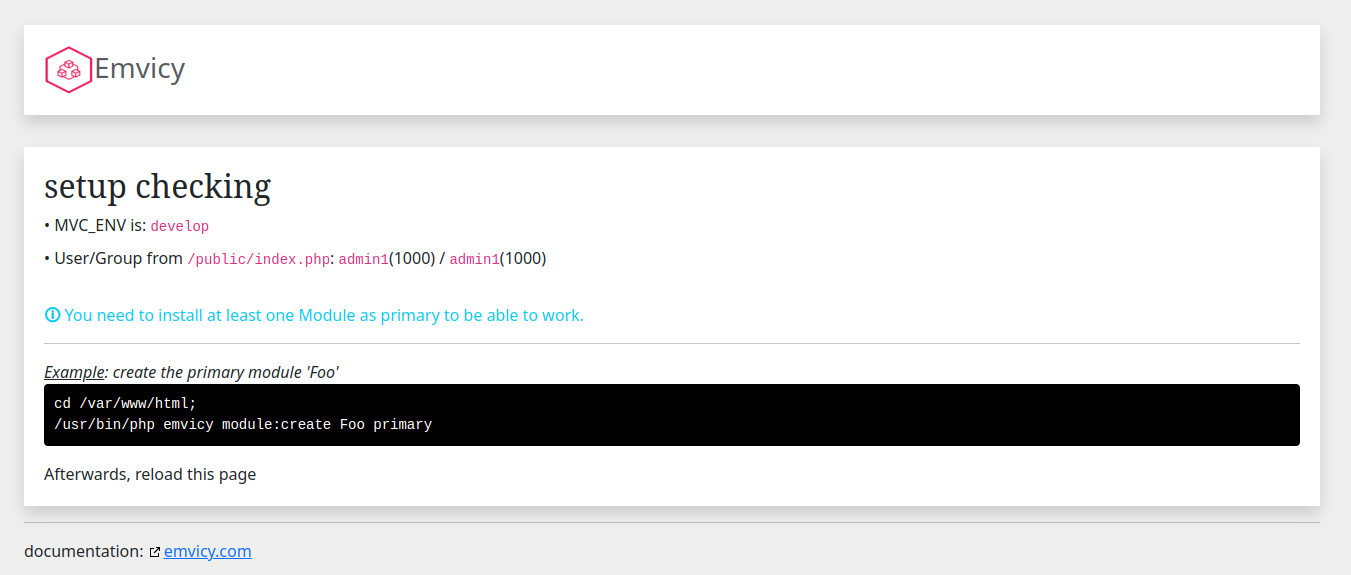
setup checking
• MVC_ENV is: develop
• User/Group from /public/index.php: admin1(1000) / admin1(1000)
• Installing required Main Application libraries via composer in Background with PID 84623. Please wait.
.......Installation completed.
Run
After that, start Emvicy's local development server.
php emvicy serveExample output
admin1@erazer:/var/www/html$ php emvicy serve
/usr/bin/php -S 127.0.0.1:1969 -t ./public/
--------------------------------------------------------------------------------
[Sun Feb 2 13:24:12 2025] PHP 8.4.3 Development Server (http://127.0.0.1:1969) started
Now you can call your application in your web browser at http://127.0.0.1:1969.
You should see this Frontend
Using ddev
🛈 This command installs Emvicy2 at the location where it gets called and configures and runs it as a ddev project.
bash <(curl -s https://emvicy.com/Installers/Emvicy_2.x_ddev.sh);- for more Information about this Installer see github.com/emvicy/Installers?tab=readme-ov-file#emvicy2ddev
disclaimer
- I do not accept responsibility for any damage, errors or anything whatsoever caused by running or using this script.
- You use this script at your own risk.
Find out more about ddev and how to install. If you are not yet familiar with this great tool, I highly recommend that you take a look at it. It will make your development much easier.
Requirements
Operating System
- Linux
- binaries available:
sed, find, grep, mv, xargs, rm, ps
PHP
- Version:
>=8.4
You also need some PHP-Extensions installed and PHP-functions enabled as listed below.
Example: how to install PHP 8.5 with all required PHP Extensions on Ubuntu Linux
sudo apt update
sudo apt install php8.5
sudo apt install php8.5-common php8.5-curl php8.5-mbstring php8.5-xml php8.5-zip php8.5-intl
Required PHP Extensions
| Required Extension | Package |
|---|---|
| Core, ctype, date, fileinfo, filter, iconv, json, Phar, posix, Reflection, session, SPL, standard, PDO | php8.5-common |
| curl | php8.5-curl |
| mbstring | php8.5-mbstring |
| dom, SimpleXML | php8.5-xml |
| zip | php8.5-zip |
| intl | php8.5-intl |